author

Sofia Brennan
Client Experience & Project Director
The kitchen is the room that gets the most attention in any home renovation or new build brief — and for good reason. It's where most households spend a significant proportion of their waking hours. It's where the family gathers. It's where you feed people you love. And it's one of the most complex rooms in the house from a functional and design perspective.
Here's how we think about kitchen design at Denvra.
Start With How You Actually Cook
The best kitchen for you is not the kitchen that photographs best — it's the kitchen that suits how you actually use it. A serious home cook who batch-prepares meals needs different things from a kitchen than a household that mostly heats and assembles. An entertainer who wants guests in the kitchen during dinner parties needs different sight lines and social geometry than a household that prefers the kitchen separate from the living space.
Before any design decisions are made, we ask clients to describe their cooking in detail. What do you cook most often? How many people are cooking at once? Do you like having company in the kitchen or do you prefer it private? What frustrates you about your current kitchen? What do you love about kitchens you've used elsewhere?
The answers shape everything that follows.
The Work Triangle Is a Starting Point, Not a Rule
You've probably heard of the kitchen work triangle — the spatial relationship between the sink, cooktop, and refrigerator. It's a useful concept but it's often applied too rigidly. Modern kitchens, particularly those that include islands or are part of open-plan living spaces, rarely conform to a simple triangle.
What matters is that the most frequent movements in the kitchen are short and unobstructed. You should be able to move from cooktop to bench to sink without crossing traffic coming through the space. You should be able to open the refrigerator without blocking anyone's path. The dishwasher should be close enough to the sink to make stacking simple.
Storage That Reflects Reality
Most kitchen storage is designed for the kitchen someone imagines they have rather than the kitchen they actually have. Real kitchens contain bulky appliances, oversized pots, rarely-used gadgets, and a disturbing quantity of plastic containers.
Design storage for what you actually own, not for a curated selection of identical white ceramic. This means:
Deep drawers for pots and pans rather than shelves, which waste vertical space
Designated appliance garages for things like toasters and coffee machines that you use daily but don't want visible
Pantry storage that's accessible rather than deep and dark
Bin storage that's convenient to the main prep area
Joinery and Materials
The material choices in a kitchen have to balance beauty, durability, and practicality in a way that few other rooms require. Some general principles:
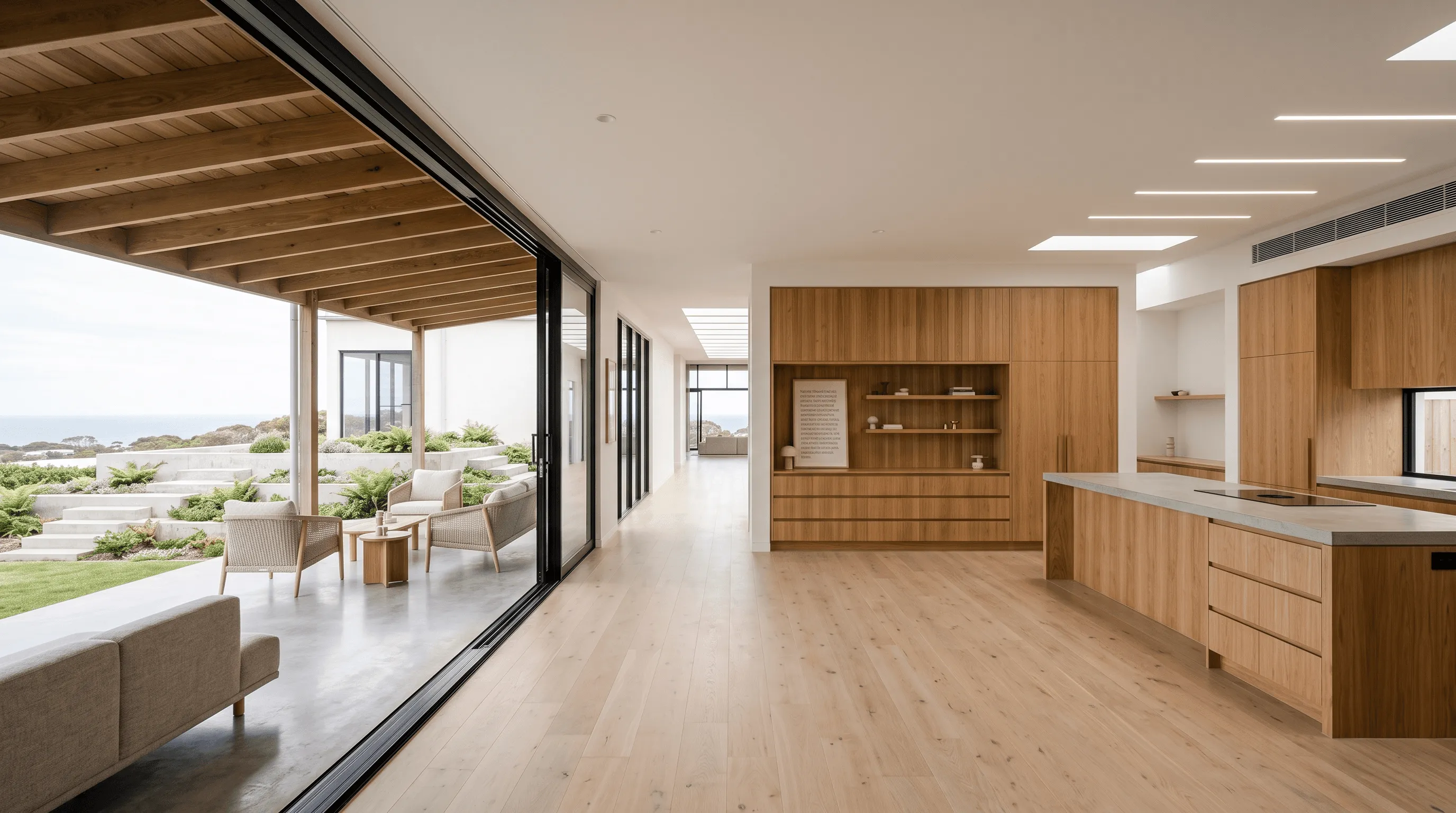
Benchtop materials should be heat, scratch, and stain resistant — engineered stone performs well but requires sealing; timber is beautiful but demanding; stainless steel is indestructible and surprisingly warm in the right context
Cabinet finishes should be chosen knowing they'll be touched constantly — highly reflective lacquered finishes show fingerprints; timber veneers soften with use; painted finishes chip at edges if quality isn't high
Splashbacks are an opportunity for a material moment — consider extending the benchtop material up the wall for a seamless look, or using a single large-format tile that makes the junction between surfaces simple and easy to clean
Lighting in Three Layers
Kitchen lighting is often underdesigned. A single overhead light is never sufficient. A well-lit kitchen has:
Ambient lighting that fills the room generally
Task lighting directly over benchtops and the island, ideally under-cabinet LED strip
Accent lighting that gives the kitchen character in the evening — above-cabinet lighting that glows up into a raked ceiling, or pendants over an island that provide warmth when the task lights are off
The kitchen you spend your mornings and evenings in should feel as considered at 7pm as it does at 10am.